How to check if ChatGPT recommends your brand
 By Daniela Ricaud, founder of Pretty Citable
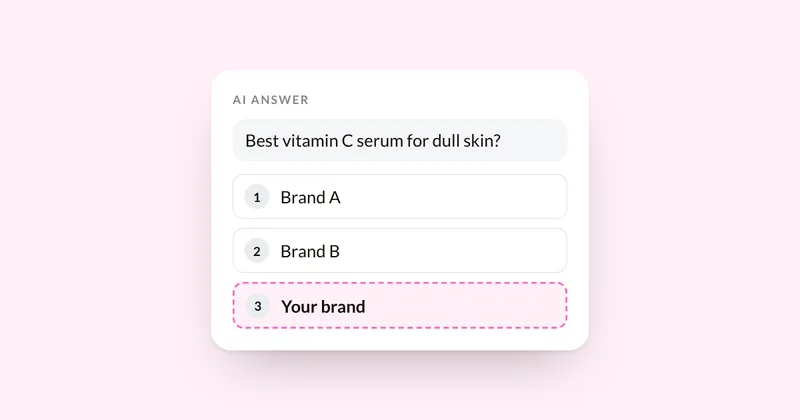
Ask ChatGPT, Google AI Mode, Perplexity and Claude the questions your buyers ask, in a logged-out or private window, and write down every brand each one names. Use the same questions every time, save a dated screenshot of each answer, and repeat the test every month so you can see what changes.
Step 1: Write the questions your buyers actually ask
Shoppers rarely type your brand name. They ask about the problem, the product type or the occasion. Write 10 to 30 questions in your buyers' words and leave your brand name out of all of them. Cover these six kinds:
- Discovery: "What's the best vitamin C serum right now?"
- Price: "Best vitamin C serum under $50"
- Problem: "Vitamin C serum for dark spots that actually works"
- Trust: "Which vitamin C serum do dermatologists recommend?"
- Comparison: "Is a luxury vitamin C serum worth it over a drugstore one?"
- Gift: "Best skincare gift with a vitamin C serum under $100"
Step 2: Use clean sessions
AI assistants can shape answers around your account, your history and your location. Run every question in a logged-out or private window so you see roughly what a new shopper sees. Answers can also change by country, so test from the market you sell in. If you sell in the US and you're somewhere else, use a US connection.
Step 3: Ask every question on all four engines
Each engine pulls its answers from a different place, so a brand can be named in one and missing from the next. Test ChatGPT, Google AI Mode (or AI Overviews), Perplexity and Claude. Here's where each one gets its answers.
Step 4: Record who gets named, and how
For every answer, write down which brands were named, in what order, and which websites the engine cited as sources. Then look closer:
- Mentioned or recommended? Your name appearing in a list of "brands to avoid" is a very different result from being the answer to "which one should I buy?"
- Does the source back the claim? Open the cited page and check that it actually says what the answer says about you: the right product, price and details.
- Where do the links go? Note whether a link in the answer points to your homepage, the exact product page, or someone else's site.
- Did you lead the question? If you typed your brand name or pasted a link, the engine was comparing candidates you chose. Log those runs separately from open questions.
Take a screenshot that shows the date. Without the screenshot, nobody can check the finding later, including you.
Step 5: Count and compare
Add it up. How many answers named you, out of the total? Which competitor got named most? Which sources kept showing up? Those sources are where your work belongs: the review sites, publications, videos and comparison pages the engines already trust in your category.
Don't judge from one check
AI answers move around daily. When Ahrefs tracked about 37,500 citations across five AI tools for 20 days, 50% to 83% of them were gone the next day, and about 75% of those came back within the 20 days. Ahrefs suggests counting how many of the last seven days you were cited. A single screenshot is a snapshot, so repeat your most important questions on a few different days before you draw a conclusion.
How often to check again
Rerun the full question set once a month, in the same conditions, and compare. Changing the questions breaks the comparison, so add new ones as extras and keep the original set.
Sources
See where your brand stands
Run three buyer questions yourself in 60 seconds, or get the full AI Visibility Audit: 30 questions on four engines, a competitor map and a ranked fix list in 5 business days.